
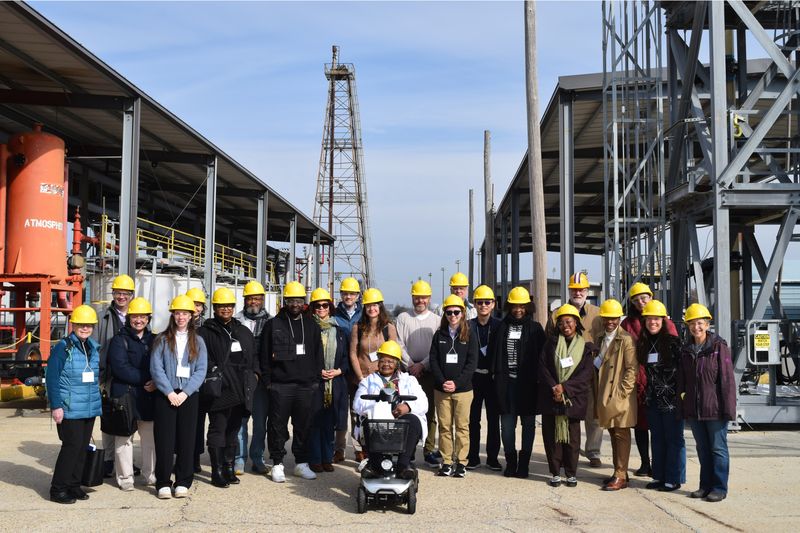
SCoRE is excited to share that our work on community engagement around emerging energy transition technologies (EETTs) was featured by Sustainability at Georgia Tech. The article, “From the Ground Up: How University-Community Partnerships Are Advancing the Energy Transition,” highlights the Southeast Community Energy Futures Academy (SCEFA). SCEFA is a regional leadership and education initiative that brings together community leaders, researchers, technologists, and other stakeholders from across the Southeast. Together they explore both the promise and the challenges of EETTs such as direct air capture, hydrogen, battery technologies, and carbon capture.
The story features SCoRE’s community-engaged sustainability project manager Alexandra Rodríguez Dalmau and senior director Jennifer Hirsch. It also includes reflections from Matthew Realff, professor in the School of Chemical and Biomolecular Engineering and faculty director for Interdisciplinary Sustainability Education at the Brook Byers Institute for Sustainable Systems, and from Tim Lieuwen, Georgia Tech’s executive vice president for Research.
SCEFA grew out of a regional community engagement program connected to the Southeast Direct Air Capture Hub (SEDAC). SEDAC is a U.S. Department of Energy-funded initiative led by the Southern States Energy Board. As conversations about direct air capture unfolded, it became clear that communities asked to host energy facilities often bear immediate, local risks while the benefits feel distant. Those same questions applied across the wider set of emerging energy transition technologies. As Rodríguez Dalmau puts it, “The goal is not to convince communities to support a particular technology.” Instead, the program aims to help everyone understand the opportunities, tradeoffs, and impacts together.
SCEFA treats community partners as experts in local history, priorities, and concerns. Participants take part in presentations, working sessions, mapping exercises, and laboratory tours. They also make site visits to industrial and research facilities and to neighborhoods shaped by past industrial development. Over the past year, teams from Georgia, Alabama, Mississippi, and Louisiana met in online workshops and at two in-person gatherings. The first was hosted by Louisiana State University in Baton Rouge and the second by the University of South Alabama in Mobile. The teams developed education and outreach materials for community-based organizations:
SCEFA builds on more than a decade of SCoRE’s relationship- and project-building work, and it is already showing results. Technologists in the program are more interested in engaging communities earlier in their research. Researchers are finding clearer ways to communicate their findings. Community partners are gaining the knowledge and tools to engage on their own terms when new projects are proposed.
Read the full story on Sustainability at Georgia Tech. If you are interested in learning more about SCEFA or getting involved, we would love to hear from you! Feel free to get in touch: Alexandra Rodríguez Dalmau, Jennifer Hirsch.