
During my Sustainable Communities Summer Internship with SCoRE working with the Southeast Communities Energy Futures Academy (SCEFA) program, I was able to experience two exciting and informative events. The first was a visit to GE Vernova’s gas turbine manufacturing facility in Greenville, South Carolina with SCEFA's sister program, the Carbon Management Fellowship Program. The second was a weekend at the 4th annual Southeast Environmental Justice Summit with both the SCEFA and other Sustainable Communities Summer interns. Both experiences taught me about the state of the energy industry and its transition for a more sustainable future. I learned from experts across different fields, broadened my network and community, and had plenty of fun.
GE Vernova is an energy equipment manufacturing and services company, formed in 2024 as part of the three-way division of the General Electric company founded in 1892 by Thomas Edison. Today, GE Verona is the global leader in gas turbine manufacturing, helping to produce approximately 25% of the world’s electricity(GE Vernova, 2026). This past summer, as part of my internship with the Sustainable Communities Summer Internship Program, where I interned with SCoRE and the Southeast Community Energy Futures Academy (SCEFA), I had the opportunity to join SCEFA's sister program, the Carbon Management Fellowship Program, on a visit to GE Vernova’s gas turbine manufacturing facility in Greenville, South Carolina. I traveled there with my supervisor, Alexandra Rodriguez Dalmau, Dr. Taeisha Smith, and a cohort of fellows who were in the midst of creating a case study surrounding carbon management on power plants. This program, along with the program I interned for, is immersed in the climate question and the actions we must take to answer it. How can we prevent new emissions from entering the atmosphere? What do we do about the emissions that are already here? What responsibility do the corporations that provide our fuel have to their communities?
During the visit, I had the opportunity to hear from 5 different speakers, employees of GE Verona, whose different experiences and expertise in their fields, painted a broad picture of the operations at the company in its different sectors. The visit began with a tour of GE Verona’s turbine manufacturing site, led by one of the company’s engineers. Here, he discussed the differences in how the turbines functioned depending on their use cases and customer interests, then introduced the company’s hybrid gas and hydrogen powered turbines. This blended fuel can be marked as one success in the path the company has laid out to operate carbon-neutrally by 2030, with the end goal he noted to be commercially available full hydrogen fuel.
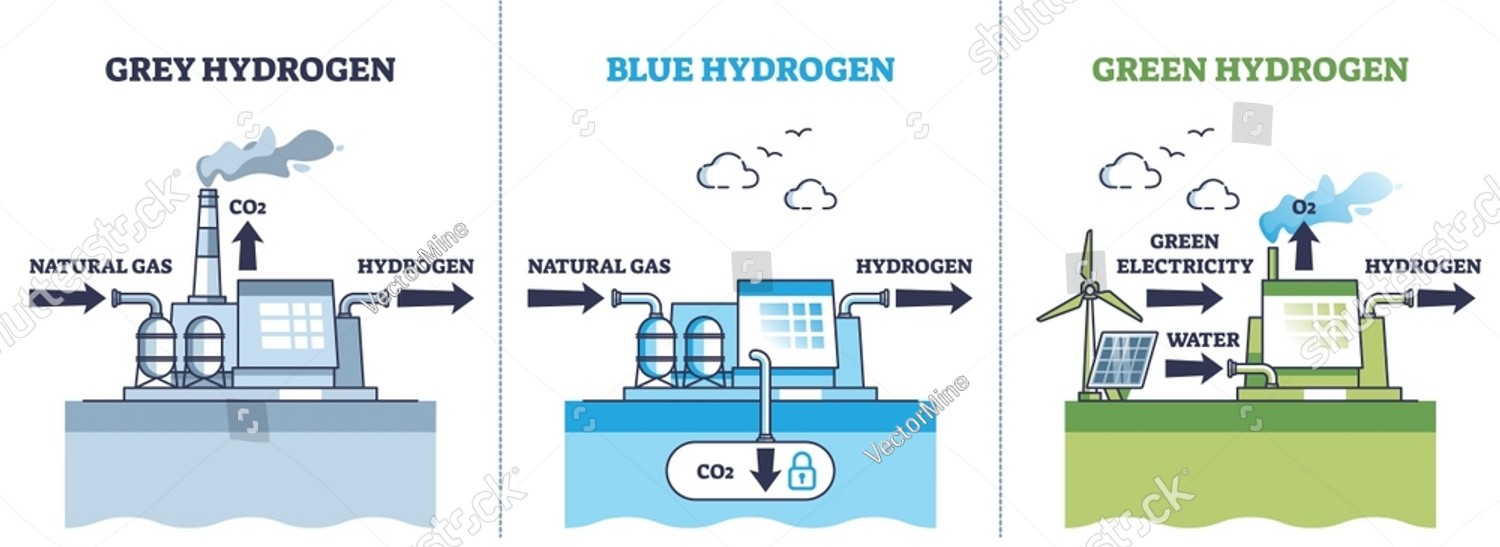
The use of hydrogen as a vehicle for carbon neutral energy is generally underdiscussed in conversations about an industry wide energy transition, overshadowed by other renewables and carbon capture technology. Green hydrogen fuel, generated using renewable electricity, is the ideal type of hydrogen as an alternative energy source, but it is the most expensive and largely underused. Grey hydrogen is cheaper and most commonly used, but criticized because of its generation via fossil fuels, putting into question its viability as the future of sustainable energy.
Because GE Verona outsources its hydrogen supply, questions can arise about how much carbon is emitted throughout the product lifecycle of hybrid powered and hydrogen powered turbines. A proper understanding of what makes a product or fuel sustainable requires us to zoom out and consider every actor in the assembly line of production, not the product’s emission output alone. To help with this understanding, emissions are categorized in scopes which describe each stage of the production process that a pollutant or greenhouse gas is emitted. Scope 1 emissions are directly produced from a company’s operations, Scope 2 emissions come from the energy a company purchases and uses, and Scope 3 emissions come from activities across the broader value chain. Scope 3 emissions are the most difficult to track and are often where emissions are produced but not immediately visible to consumers.
For example, imagine a company trying to lower their emissions by creating a turbine that runs on hydrogen fuel instead of natural gas fuel. If the company chooses to produce the hydrogen fuel themselves, using their own facilities, the emissions produced from the process would generally fall within scope 1 emissions (and potentially Scope 2 if purchased electricity is involved). They could choose to produce grey hydrogen which would not lower these emissions, or they could choose to produce green hydrogen which would lower these emissions. If the company purchases hydrogen from an external supplier instead of producing it themselves, the emissions from producing that hydrogen would typically fall under Scope 3 because they occur elsewhere in the value chain. As a result, a focus may be placed on the lower emissions produced by the turbine while it is running which can overlook significant emissions generated during the fuel's production.
This does not mean that hydrogen fuel, neither green nor gray, needs to be written off or considered a waste of effort by companies like GE Vernova and their suppliers. Hydrogen’s advantage is its flexibility and room for ingenuity. With continued research and engineering, grey hydrogen could become blue hydrogen, a process that requires emissions from grey hydrogen production to be captured using carbon capture utilization and storage technology. This could result in lower scope 3 emissions as the captured carbon could be repurposed or stored away from the atmosphere.
Though underdiscussed, blue hydrogen is not an unrealistic future, especially not at GE. After our plant tour, we heard from two early career employees who discussed the range of opportunities available to those working at or looking to work at GE from mechanical engineering to computer science. They described the company culture as very involved and immersive, allowing their interns and new employees to experience different sectors of the company. This was further elaborated by the speakers who followed. Ellen Walsh and Kassy Hart, career employees, discussed how they had found niches within the company related to an industry wide energy transition. Hart, a Data Centers & H2 Commercialization Leader, described how flexible the company had been for her, noting how her career began in engineering and transitioned into a position in strategy tailored to an important and viable hole in the energy market. Walsh, a Direct Air Capture (DAC) Program Manager, discussed DAC research and the challenges companies are facing in the development and deployment of sustainable technologies, even for an established brand like GE Vernova. She noted how many companies attempt to jump too fast into innovations with proof of investment capacity. Clients want to see evidence, they want reliability, and they want products that will be worth their money. Because of this, both research and deployment efforts have taken a steadier, more modest approach to development.
However, one question that can be raised is if this steady effort will be able to keep up with the damage that has already been done by industry since the industrial revolution. The sustainable vision that GE Vernova currently has not always been reflected by the company. Before General Electric split into the three companies we know today, GE Healthcare, GE Aerospace, and GE Vernova, CEO Jack Welch altered the business structure from one solely focused on the creation of quality products to a vested interest in capital growth through other avenues besides reputable production practices and innovation. One of the consequences of this endeavor was a disregard for sustainable and environmentally conscious practices, which left the company’s engineering division behind as demand for green products grew. To become a leader in green technology, GE would have to focus on innovation, which they are making progress in, but they must also assess the social and economic landscape. There is an undeniable urgency for an energy transition to combat climate change, but societal attitudes and profit incentives often make the path forward appear more contested than it is. Though their reputation holds some weight as a historical household name, GE sells a consumer product, and its ability to continue profitably is at the whim of said consumers. If there is less of a societal and economic incentive for companies to seek out energy from a sustainable source, then it is difficult to push those products.
GE has collaborated with Georgia Tech on many occasions and has employed many of its students via internships and full-time positions for alumni. The company is a large corporate sponsor that supports our students and researchers in their efforts to show a commitment to the energy transition. The pipeline between GT and GE as well as other similar industry actors showcases the investment many have in academia, research, and the younger participants in these areas. Much of the innovation in the energy sector is driven by research and collaboration between industry and academia. Both the new hires and career employees that I had the pleasure of hearing from described a culture that values the ideas and direction of those who work for them. Their research institute speaks to this culture and intention of the company. To me, this is evidence of notable individual efforts from brilliant minds to push forth an energy transition. At the same time, organizations with the scale, expertise, and resources of GE Vernova are uniquely positioned to contribute to broader efforts across the energy sector. I am encouraged by the work already underway and hope to see continued investments in innovation, public engagement, and educational opportunities for students and emerging professionals like myself and the Carbon Management Fellows I accompanied. By sharing knowledge, supporting the next generation of energy leaders, and continuing to develop new technologies, companies like GE Vernova can play an important role in shaping a more sustainable energy future.