
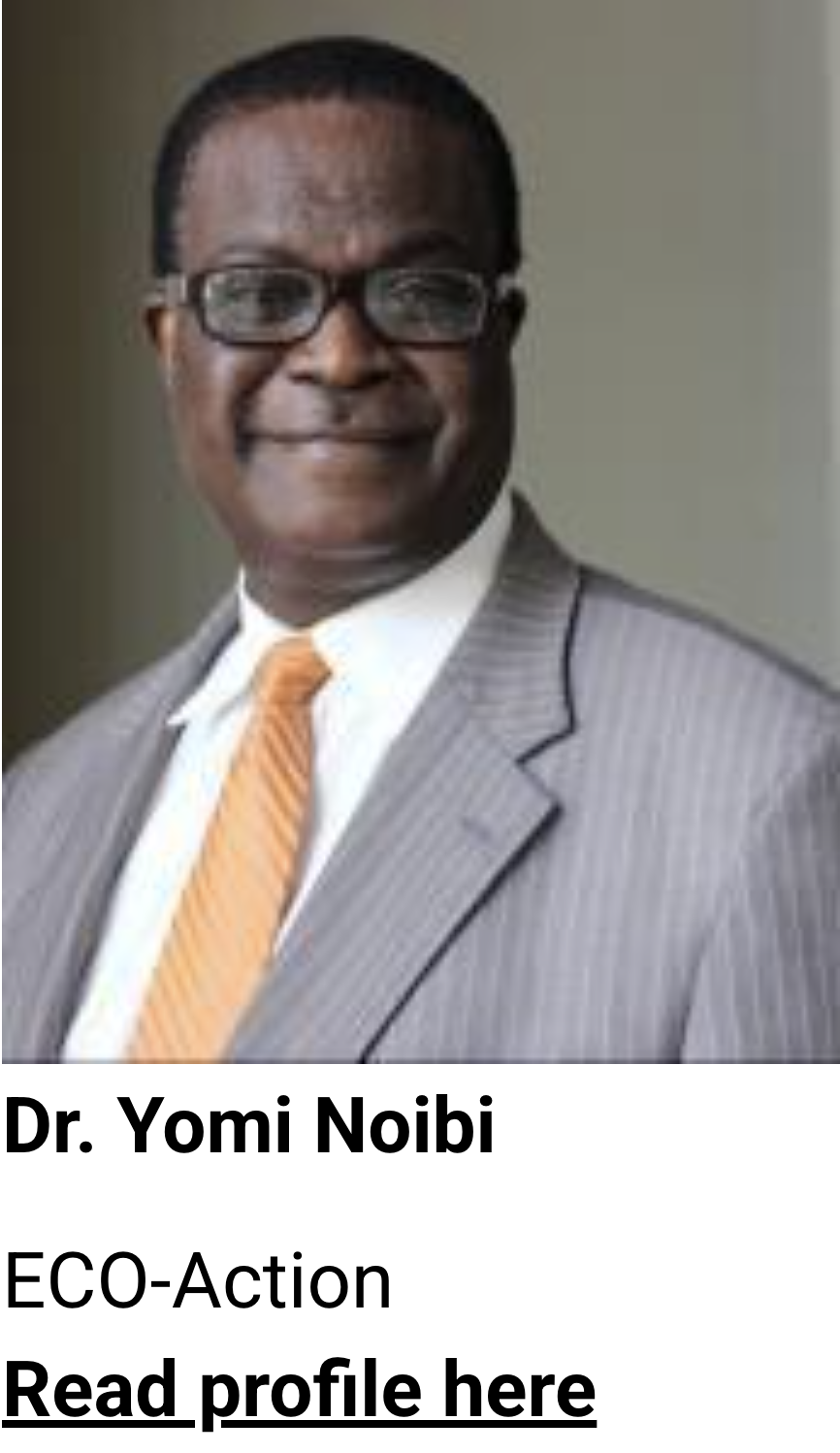
At the beginning of 2024, SCoRE launched its External Advisory Council (EAC) - a group of key partners with deep expertise in sustainability, innovation, and community engagement. As part of our ongoing series, we’re featuring interviews with our EAC members in the SCoRE newsletter. This month, we’re delighted to share an excerpt from a recent conversation between SCoRE Graduate Research Intern Taliah Smith and EAC member Dr. Yomi Noibi, Environmental Justice Advocate and Former Executive Director of Environmental Community Action (ECO-Action). Their discussion explores Dr. Yomi’s career journey, his experience in community organizing, and how his work connects with SCoRE's mission to advance sustainable communities. (Note that Dr. Yomi’s responses have been edited and condensed.)
Tell me a bit about how you got connected with SCoRE and how that relationship formed.
About ten years ago, I was introduced to Dr. Jenny Hirsch, who was the Director of the Center for Serve-Learn-Sustain (SLS), now SCoRE, through my colleague, Dr. Fatemeh Shafiei, a professor at Spelman College. We met while they were attending a green infrastructure workshop that I was facilitating at the Atlanta University Center. We discovered that we shared a passion for working with communities to advance social and environmental justice.
Later, Dr. Hirsch invited me to meet with her and members of her staff. During that meeting, we shared a conversation centered on social and environmental justice, community-engaged learning, partnerships, and respect for local knowledge. That meeting marked the beginning of what has become a lasting friendship and professional relationship. Our relationship developed naturally through mutual respect, shared values, and a common commitment to social and environmental justice. Over the years, we have collaborated with university faculty, students, and community organizations to create opportunities that strengthen both academic learning and community capacity and leadership. It has been an organic relationship built on trust, collaboration, and a shared desire to improve people's lives.
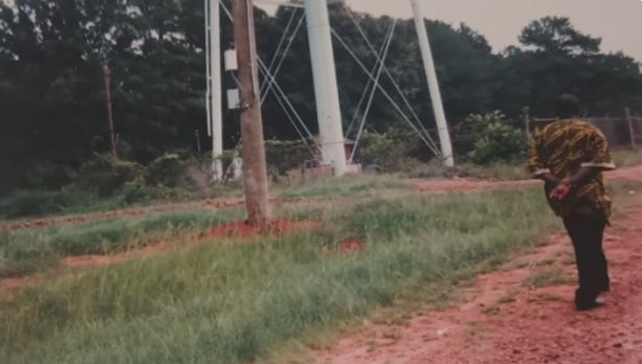
You have an interesting career, spanning sectors and different types of work. Can you walk me through your journey, from college to today?
My college education began at the Adventist College of West Africa, now Babcock University. I later earned a Bachelor of Science degree from the University of Nebraska–Lincoln and a master’s degree and Ph.D. in Science Education, specializing in Environmental Science and Industrial Hygiene, from the University of Iowa in Iowa City.
After completing my doctorate, I joined the University of Wisconsin–Green Bay, where I facilitated the teaching and learning of environmental science. What attracted me most was the university's interdisciplinary approach to teaching and solving environmental problems. UW–Green Bay provided an opportunity to experience interdisciplinary teaching and learning firsthand. I worked alongside faculty from different disciplines who collaborated in research, teaching, and service to address complex environmental challenges.
I later returned to Nigeria to serve as a Research Fellow at the University of Lagos (UNILAG), where I served for approximately ten years. At UNILAG, I helped advance capacity building and leadership development among faculty and staff at Nigeria's Science and Technical Colleges through funding from the Federal Ministry of Education and the National Board for Technical Education. Through support from the World Wildlife Fund (WWF) and the Nigerian Conservation Foundation (NCF), I also helped lay the foundation for environmental education in Nigerian colleges and universities. In addition, I designed an "Environmental Study for the Community" training program that positively impacted both the UNILAG community and surrounding neighborhoods.
In the early 1990s, I returned to the United States and taught as an adjunct professor at Clark Atlanta University before joining Environmental Community Action (ECO-Action). Joining ECO-Action as a community organizer transformed my career. It gave me the opportunity to move beyond teaching environmental science to applying it alongside communities. It was there that I truly learned that the highest purpose of knowledge is not simply to acquire it, but to use it in service to humanity.
I often tell people that ECO-Action transformed me because it allowed me to connect science, education, and community organizing into one environmental mission of connecting local communities to the resources they need to protect their environment, improve their communities, and enhance their quality of life.
I also tell my students that we often hear the phrase, "Knowledge is power." My experience has taught me something slightly different: knowledge becomes power only when it is applied to improve people's lives.
Throughout my career, collaboration has remained a constant theme. Many of ECO-Action's most successful initiatives, like our environmental justice training programs and the Atlanta Watershed Learning Network, have grown from partnerships among communities, universities, government agencies, and nonprofit organizations. Together, we have planted seeds of change that continue to grow today
What did you experience in your own personal growth while trying to grow your mission of serving communities and applying your knowledge?
Throughout my career, I have experienced moments that fundamentally changed both my thinking and my approach to leadership.One of the most influential moments occurred during graduate school. After taking a course in industrial hygiene with my professor, Dr. Clyde Berry, I asked him what additional course I could take because I wanted to continue learning from him. His response surprised me.
He simply said, "Yomi, you don't need another course from me. Go and apply what you've already learned." Those words changed my life.They taught me that we often spend our lives seeking more knowledge when what the world really needs is people who are willing to apply the knowledge they already possess. Since then, I have believed that education reaches its highest value when it improves people's lives.
Another important lesson has been the value of interdisciplinary collaboration. Environmental and public health challenges cannot be solved by one profession alone. They require scientists, educators, engineers, policymakers, and, most importantly, communities working together.
Perhaps my greatest teachers have been the communities themselves. Listening to people's lived experiences has made me a better educator, organizer, and leader. The more I learn from communities, the more I learn about myself.
Communities recognize authenticity. They know whether you genuinely care, whether your actions match your words, and whether you are willing to stand with them for the long term. Building that trust has become one of the most valuable lessons of my professional and personal journey.
Do you ever question whether you are being as effective as you want to be? How do you set goals when success depends on communities being receptive?
Yes, I regularly ask myself whether I am being as effective as I want to be. Self-reflection is an essential part of leadership and continuous improvement. At ECO-Action, we use a structured evaluation process to assess our work, learn from both our successes and our challenges, and identify ways to improve our effectiveness. Our mission guides everything we do. We exist to help communities build the power to eliminate air, land, and water pollution while creating healthier and more sustainable environments. Although our mission provides direction, the communities themselves determine the priorities. Our role is to listen, help residents identify root causes, organize around shared concerns, and connect them with the technical expertise and partnerships needed to develop lasting solutions.
One lesson we have learned is that many environmental problems are symptoms of deeper systemic issues. Our work addressing illegal tire dumping in Metro Atlanta demonstrated this. By bringing together residents, Georgia State University researchers, and Liberty Tire Recycling, we helped recycle thousands of illegally dumped tires. More importantly, that collaboration contributed to stronger tire enforcement policies across Metro Atlanta.
Another example comes from our work in Taylor County. We were invited to help address environmental concerns, but through community conversations and root-cause analysis, we discovered that the underlying issue was governance. The community had been unable to hold elections for several years because of legal barriers. By connecting residents with legal partners, elections were restored, and the community regained its voice in local decision-making. Addressing the root cause created opportunities for lasting environmental and community improvements. These experiences continually remind me that community organizing is a mutual learning process. I see myself as a servant leader. While communities learn from us, we also learn from them.
Over the years, I have also learned that meaningful community change requires patience and persistence. Trust cannot be rushed. Communities become receptive when they know you will continue showing up, listening, honoring their experiences, and standing beside them. Lasting change grows through relationships, and relationships take time.
What advice would you give to young professionals interested in following a similar path?
First, learn to listen with the goal of understanding rather than simply responding. Genuine listening is the foundation of trust and meaningful relationships.
Second, build relationships that are transformational rather than transactional. The best partnerships change everyone involved. They require humility, mutual respect, and a willingness to learn from one another.
Third, recognize that the strongest teams are built when people contribute their unique gifts toward a common purpose rather than competing for recognition. Great accomplishments are rarely achieved alone.
Fourth, practice forgiveness. Every leader will make mistakes, and so will every organization. Extending grace creates space for growth, reconciliation, and stronger partnerships.
Finally, remember that attitude shapes behavior, and behavior builds trust. Communities observe not only what we say but also how we live and serve. Authenticity, consistency, and genuine compassion are the qualities that inspire confidence and create lasting relationships.